

JVO Project
We are ...
- promoting Database Astronomy.
- developing JVO Portal searvice.
- developing system to analyse large volumes of data.
 <-- Let's try JVO portal.
 <-- Contact us.
Current status of JVO portal operation
News
2026-02-03
The new feature of FITS WebQL "Polarization Map Display" has been released. You can now view polarization maps for FITS files with NAXIS4 ≥ 2. You can try it out by selecting the data "Sagittarius_A_star" (ALMA01159411) on the FITS WebQL Demo page.

2025-11-13
XRISM Quick Look Service is now available to the public. XRISM is an X-Ray Imaging and Spectroscopy mission operated by JAXA. All data published on the JAXA DARTS web site can be viewd directly in your browser.

2025-03-16
Nearly 200 million spectral data were added to the VO crawler database.
2024-09-09
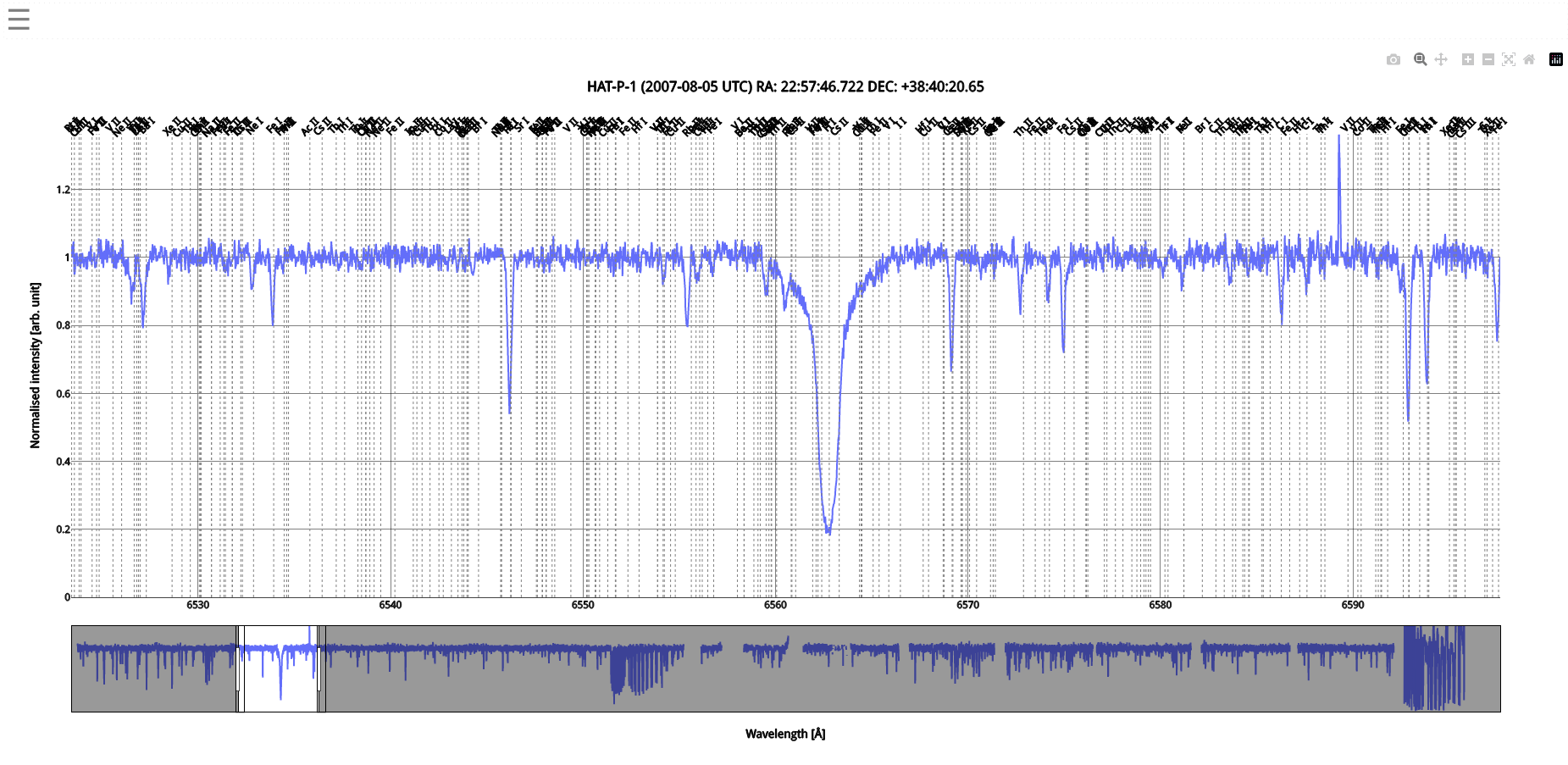
Subaru HDS Spectrum can be displayed on the FITS WebQL. Search data at HDS processed data archive, and click "WebQL" button.
2024-09-09
NRO FITS Archive is now operational. NRO FITS Archive is now available. This archive provides reduced FITS images collected through open-use observation with NRO 45 m telescope. These data were processed by CASA/pipeline.

2024-07-01
Subaru Telescope HDS processed data archive has been updated. The search interface has been redesigned, and 41,968 new automatically analyzed data are now available.

2023-09-04
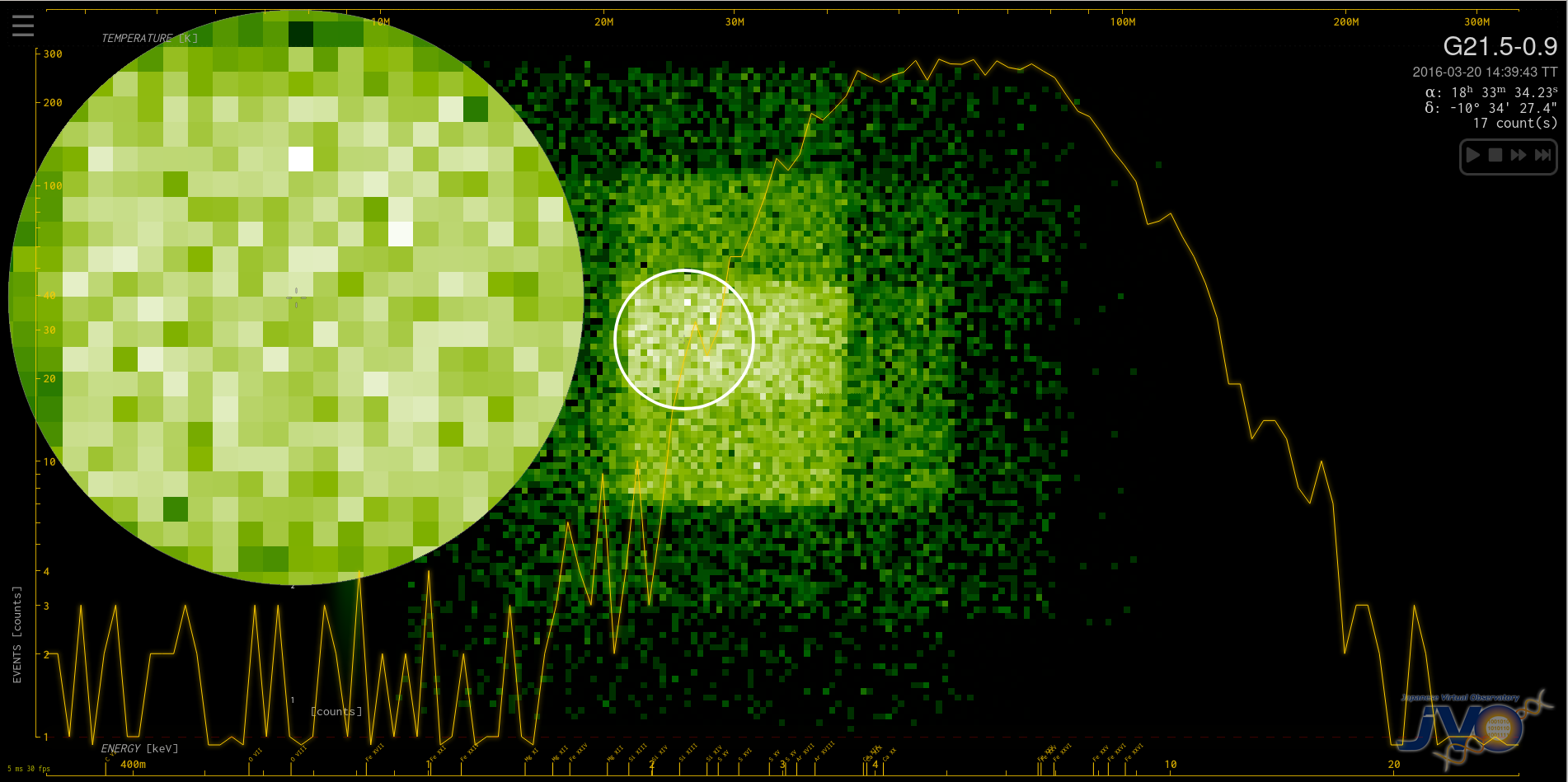
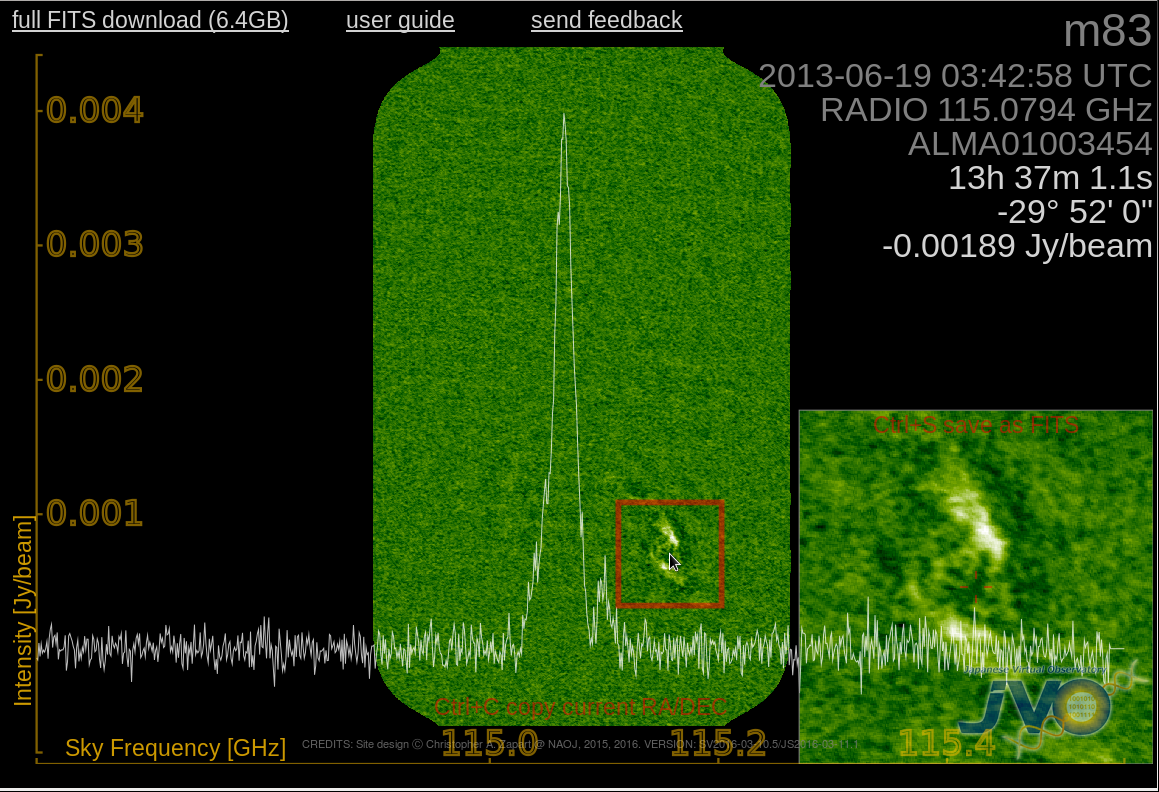
Experimental version of XWebQL, a family of FITS WebQL supporting X-ray event files, is released. You can test it at XWebQL demo page
2022-07-26
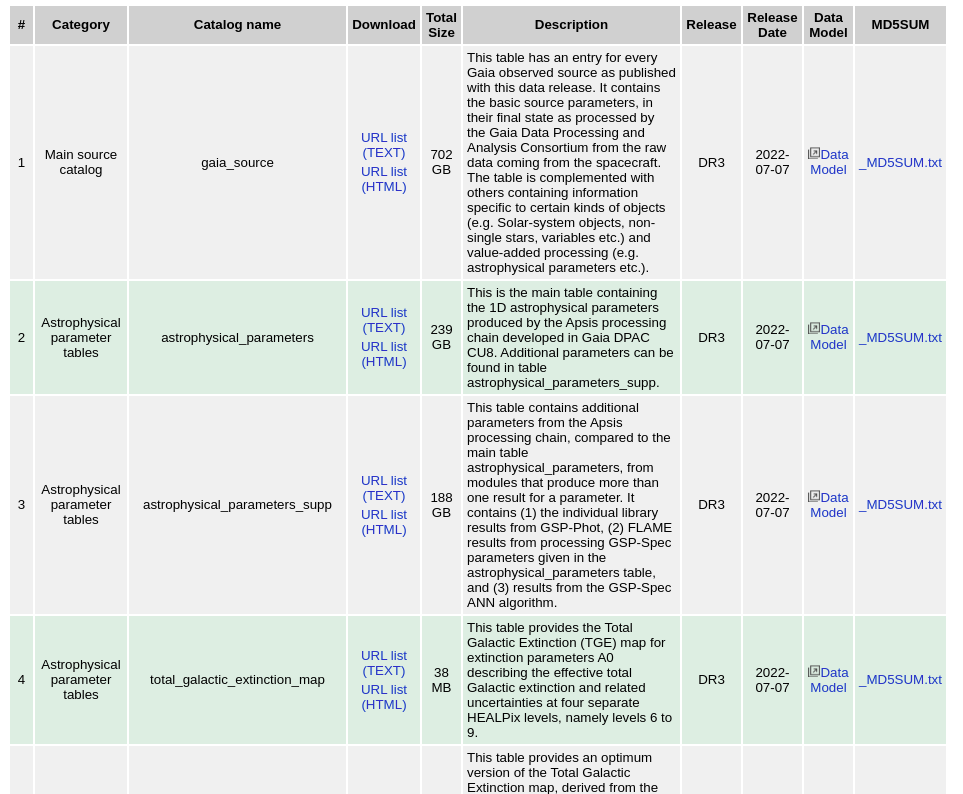
Gaia catalog DR3 data is now available. In addition to data search, file download of all catalog data, and Gaia WebQL, a simple plotting service, are available.
2022-03-12
IVOA Newsletter Vol 25 (March 2022) was published. FITS WebQL v5's large data display capability is introduced.
2021-12-23
Experimental version of FITS WebQL v5 (ditributed computing version) was released.
You can test it only at
WebQL demo page.

2021-12-23
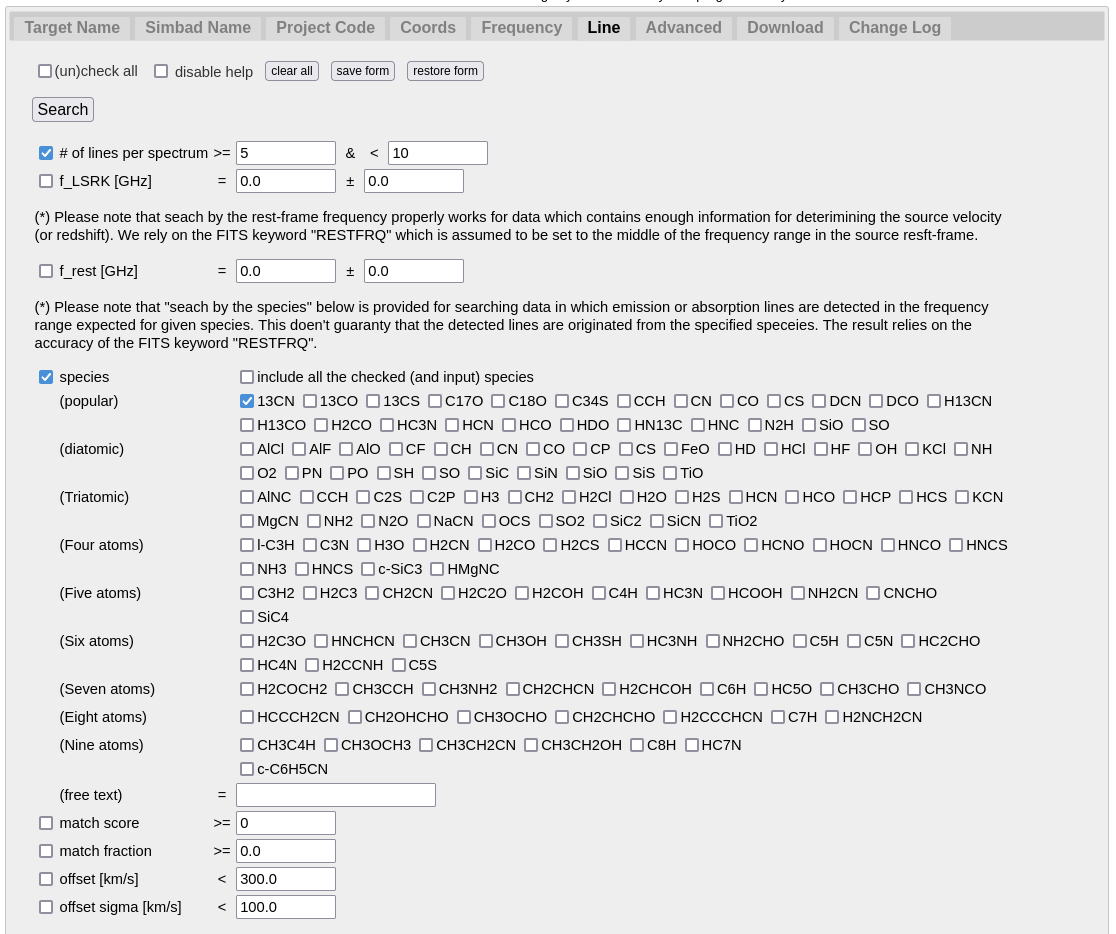
ALMA FITS Archive was updated: Experimental version of line search service is now available.
2021-03-31
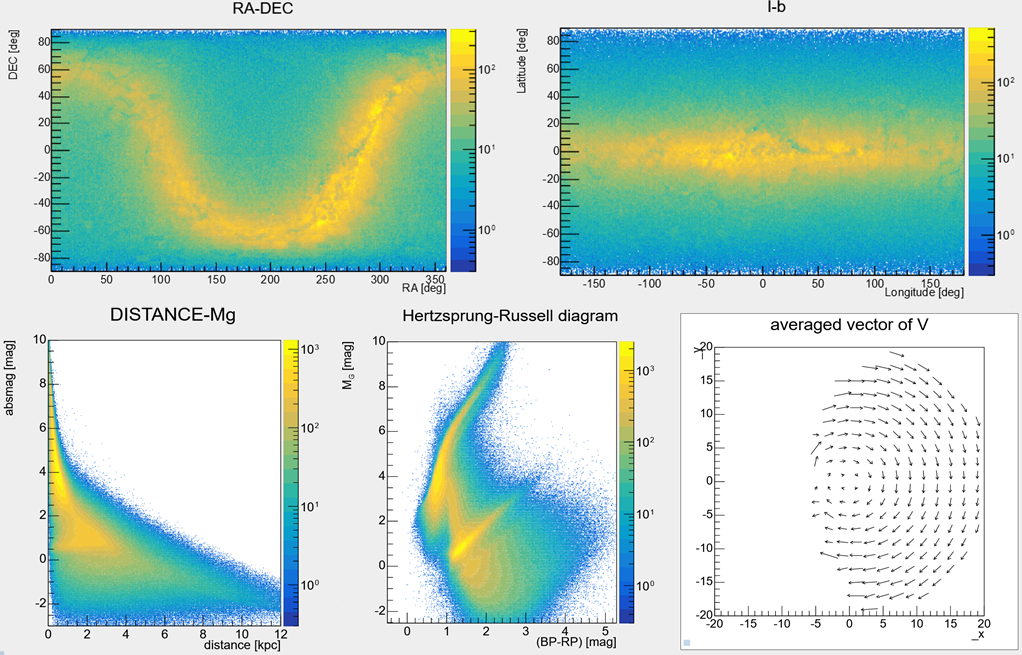
Supplementary Gaia crossmatch catalogs with AllWise, APASS DR9, GSC2.3, RAVE DR5, 2MASS PSC+XSC are now available from the JVO Gaia XMatch catalog page.

2020-08-13
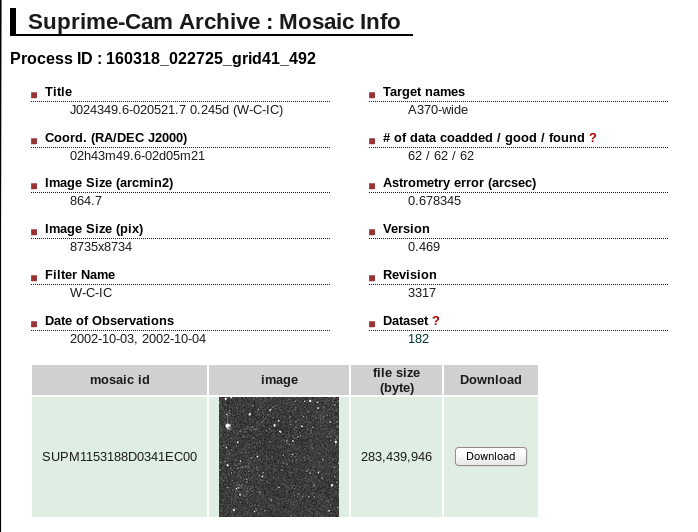
Subaru Suprime-Cam mosaic images were reprocessed with the most recent reduction pipeline, in which photometric calibration was implemented. They are avaiable at JVO Suprime-Cam mosaic image archive.
2019-10-04
Data of NRO 45m Legacy Project COMING was updated. New data for 15 galaxies were added, and data for 19 galaxies were updated.
2019-09-17
IVOA Newsletter Vol 21 (September 2019) was published.
2019-09-17
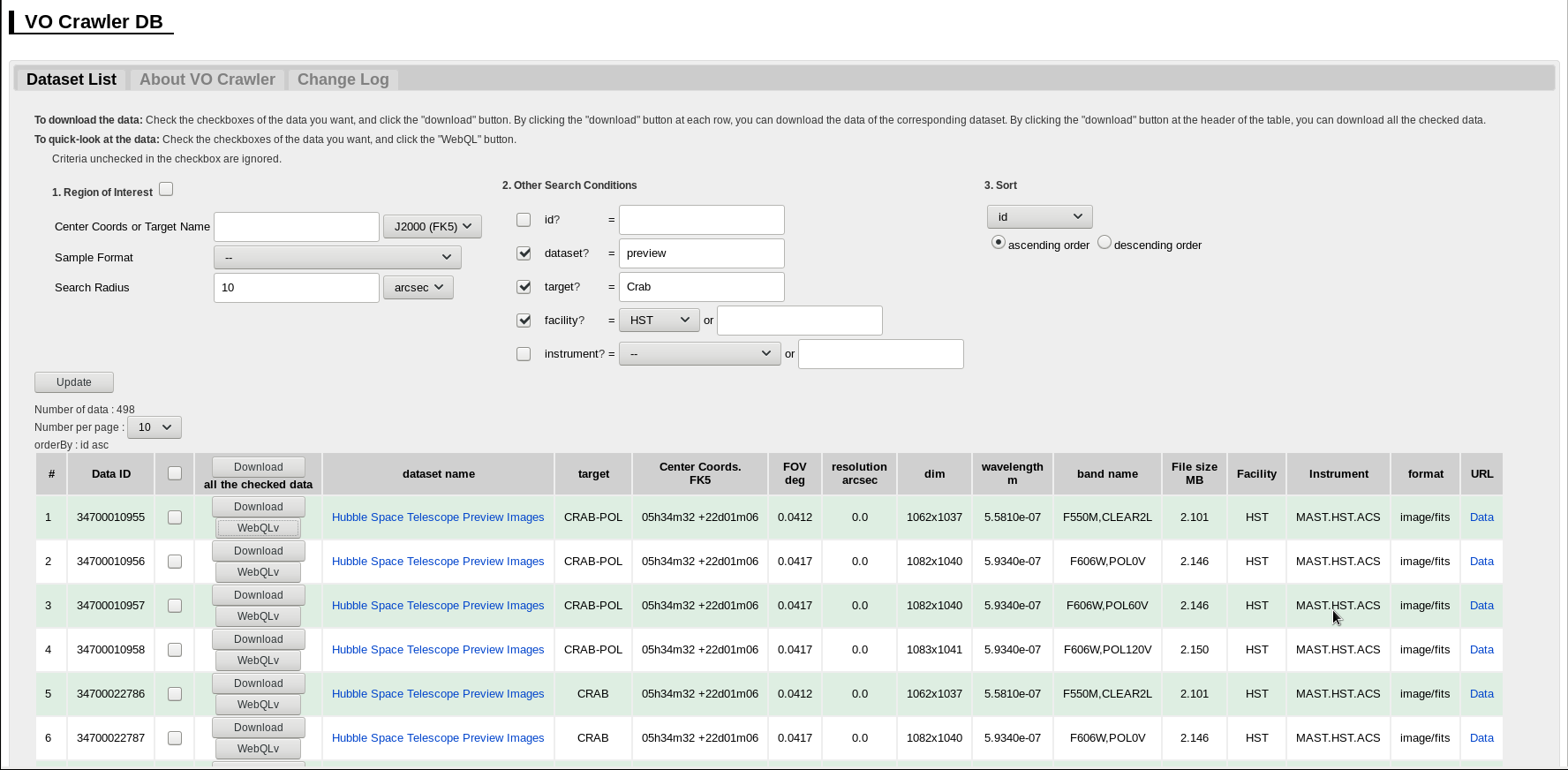
VO Crawler DB is open to the public. You can quickly search image metadata retrieved from various VO image data services.
2019-04-23
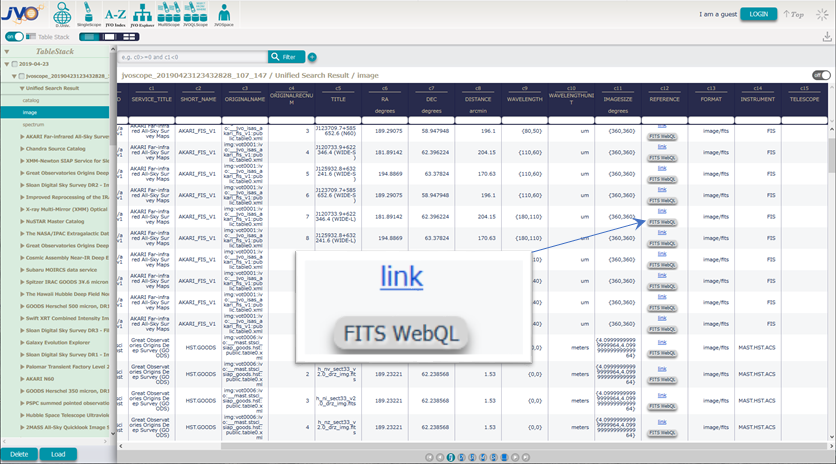
FITS WebQL button was implemented on the VO search result page. You can look at the FITS images found by the VO search interface using FITS WebQL. Try out MultiScope etc.
2019-01-29
IVOA Newsletter Vol 20 (January 2019) was published.
2018-10-17
FITS WebQL v4 (beta) was released. New feature "Cube Slicer" is abailable for ALMA/Nobeyema FITS Cube Data. Usage
FITS WebQL v4 (beta)
New feature: FITS Cube Slicer
FITS cube slicer displays the image at a frequency channel specified by a cursor. The image is updated in near real time in accordance with the movement of the cursor.
Move the cursor neare of the bottom axis, and slide it to the left or right side (along frequency axix).
In order to display the zoom-in image, push the shift key at the location where you want to see, and move the cursor to the bottom axis holding the shift key. After that you can release the key and move the cursor along the frequency axis.
2018-10-17
IVOA Newsletter Vol 19 (August 2018) was published.
2018-06-07
The data of Nobeyama 45m Legacy Project was released. The released data were taken and processed by "FUGIN", "StartFormation" project team. The data by "COMING" project will also be released soon.
2017-07-05
IVOA Newsletter Vol. 17 was published.
2017-06-26
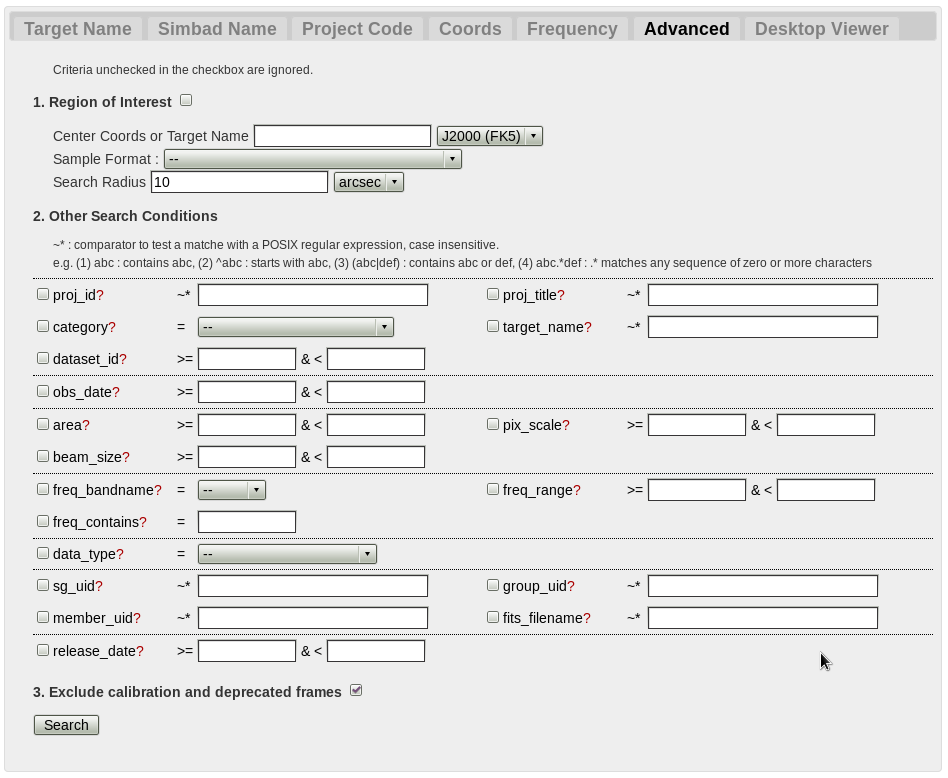
JVO ALMA FITS archive update: Advanced Search GUI was implemented. You can search the data by specifying various criteria.
2017-06-26
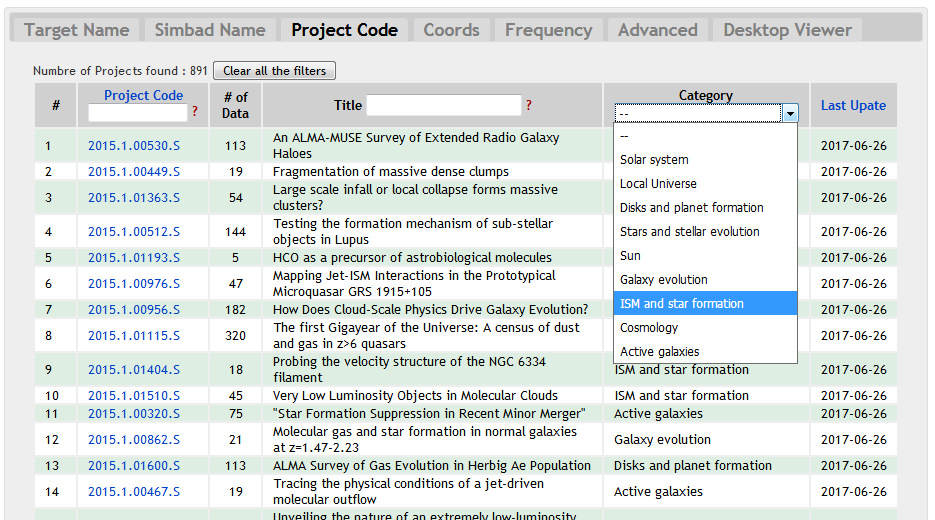
JVO ALMA FITS archive update: Functionality for filtering the projects list by their category was implemented.
2017-06-12
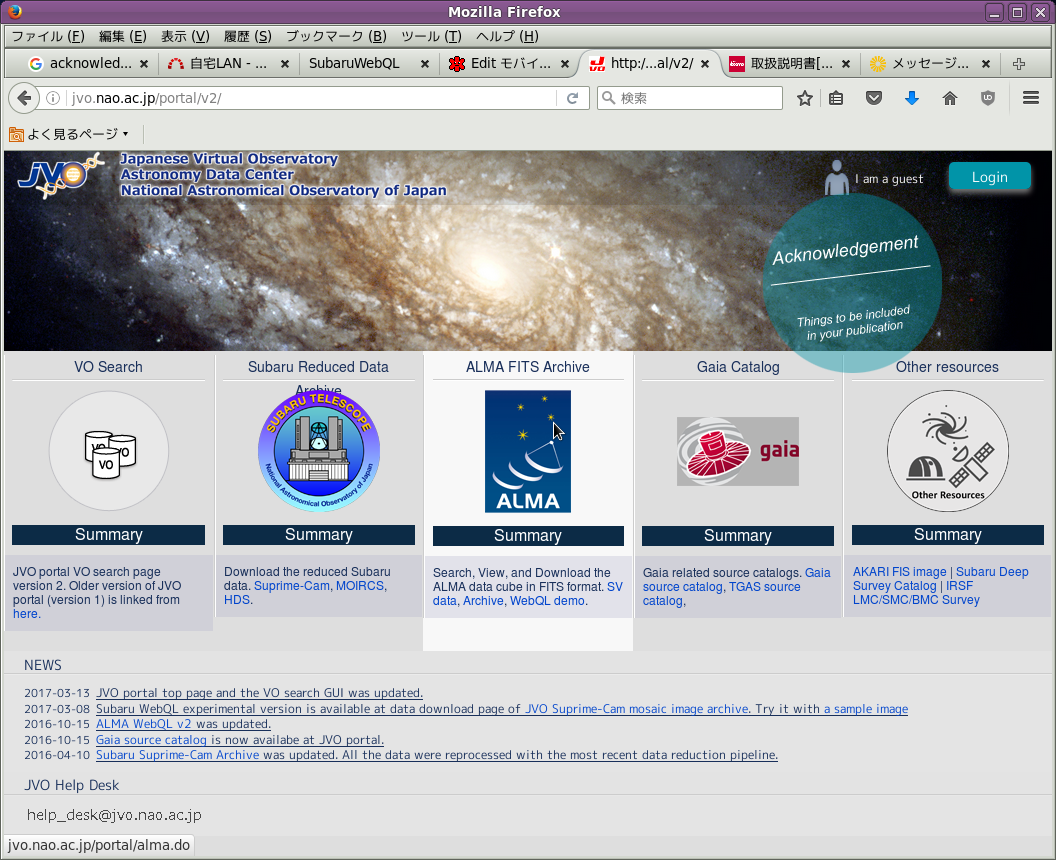
Subaru Suprime-Cam mosaic images were reprocessed with the most recent reduction pipeline, in which mosaic success rate was improved. They are avaiable at JVO Suprime-Cam mosaic image archive.
2017-03-13
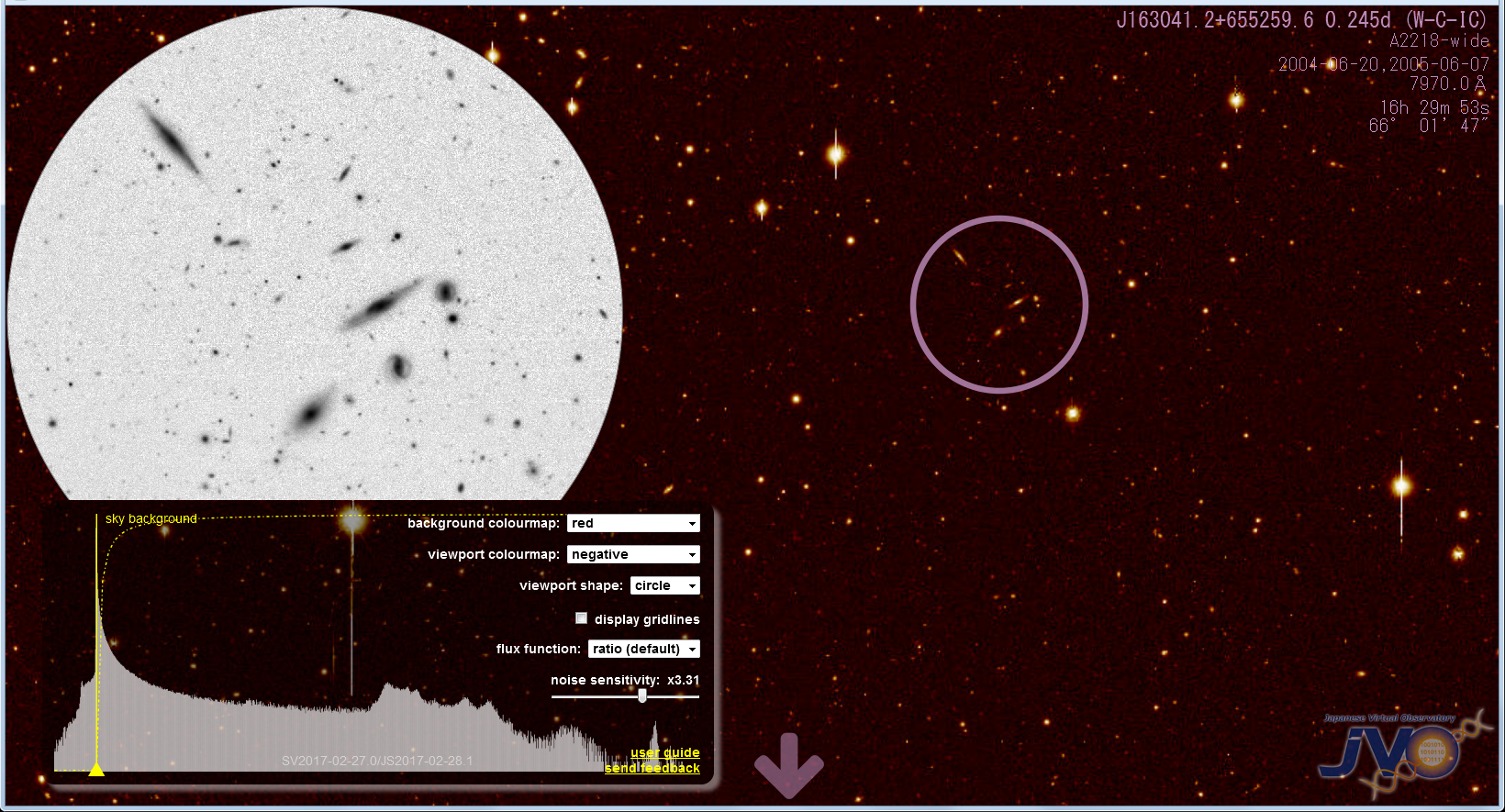
We have started the Subaru WebQL experimental operation. Go to the JVO Suprime-Cam Reduced Data Archive, select data, and click the "WebQL" button on the "Mosaic Info" page.
sample data 1: (1635+6604)
sample data 2: (1630+6553)
You can watch the promotion movie of the Subaru WebQL
2016-04-10
JVO Subaru Suprime-Cam Archive was updated.
All the data were processed with the most recent data reduction pipeline.
2015-11-19
IVOA Newsletter Vol. 15 was published.
2015-09-07
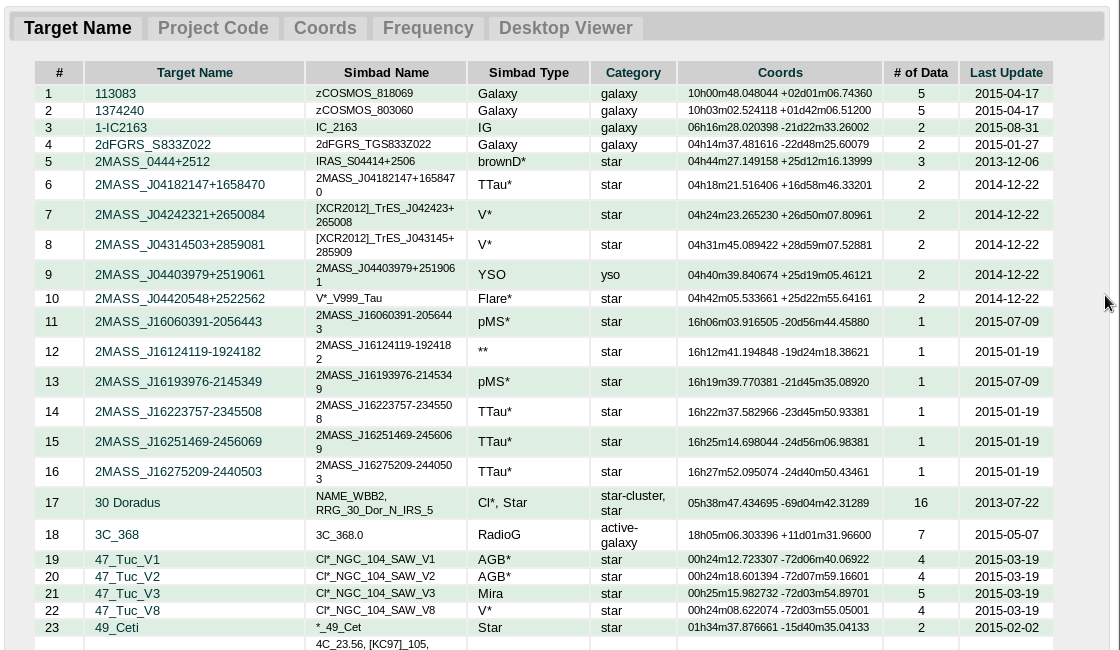
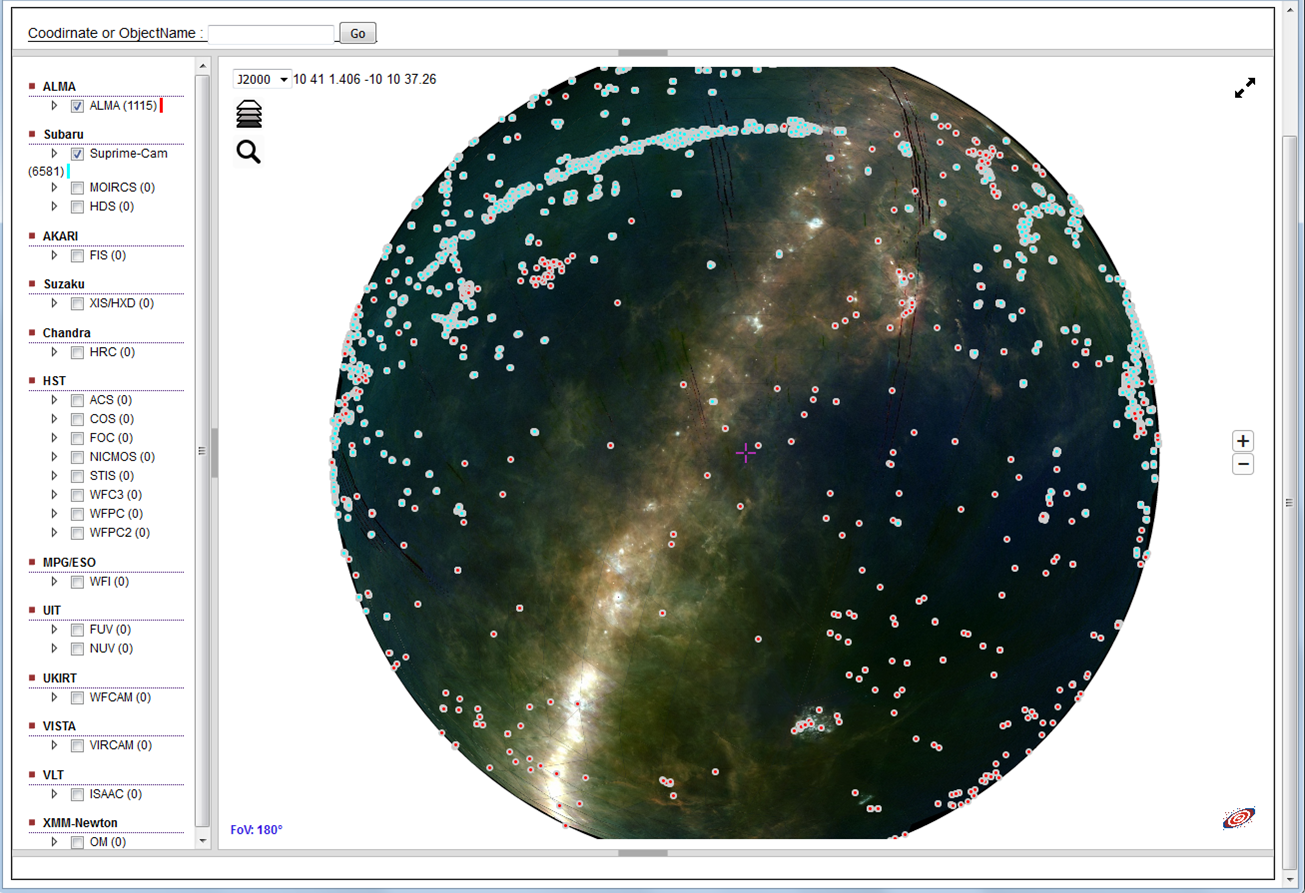
ALMA Archive has been updated. Simbad names of the target objects are shown in the target list page.
2013-02-02
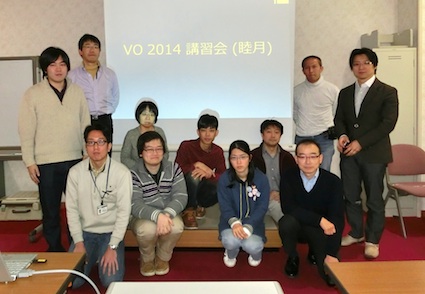
We had a "VO witer schol 2014" at NAOJ Mitaka campas during January 27-27, 2014. Lecture on how to use JVO portal and VO tools were given to eight participants. Practice to use those VO services/tools was performed by conducting one of the tree scientic researches prepared for this lecture. (Lecture Page in Japanese).
2013-10-17
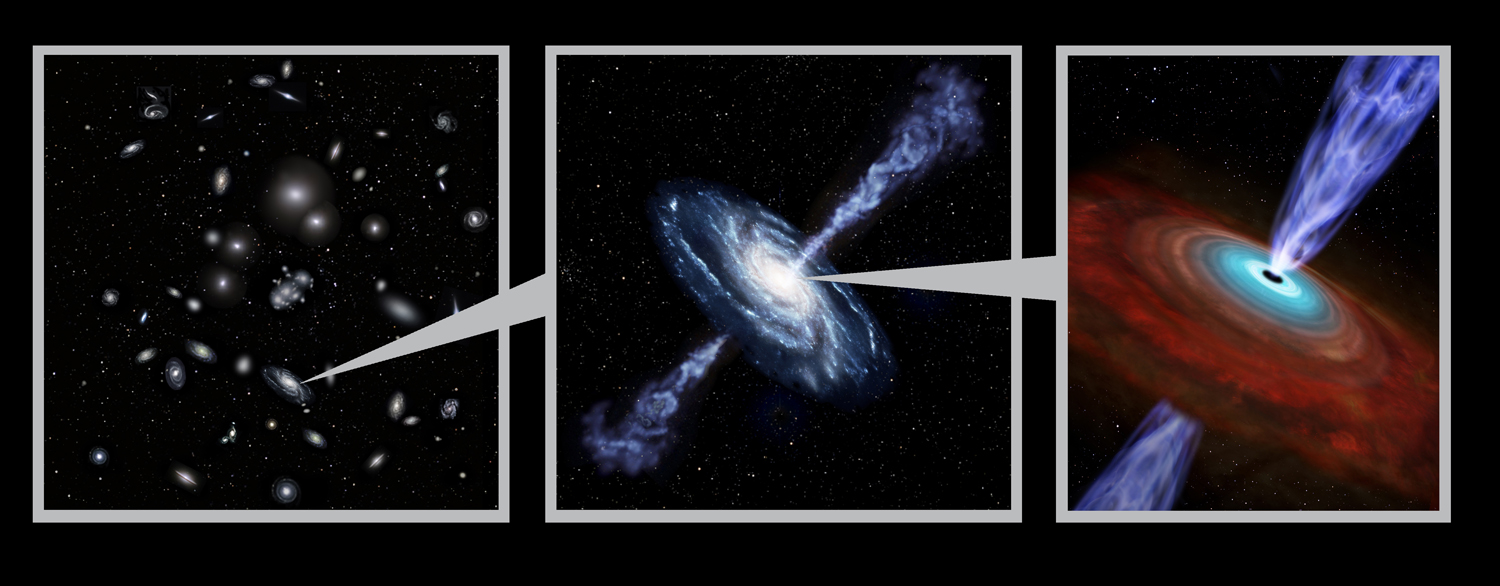
A scientific result using JVO is appeared in The Astrophysical Journal. You can see the summary of the paper in NAOJ Webpage.
2013-10-17
ADASS 2013 was held in Waikoloa, Hawaii. You can get movie and poster (pdf) displaied in our Demo Booth about ALMA VO serviece.
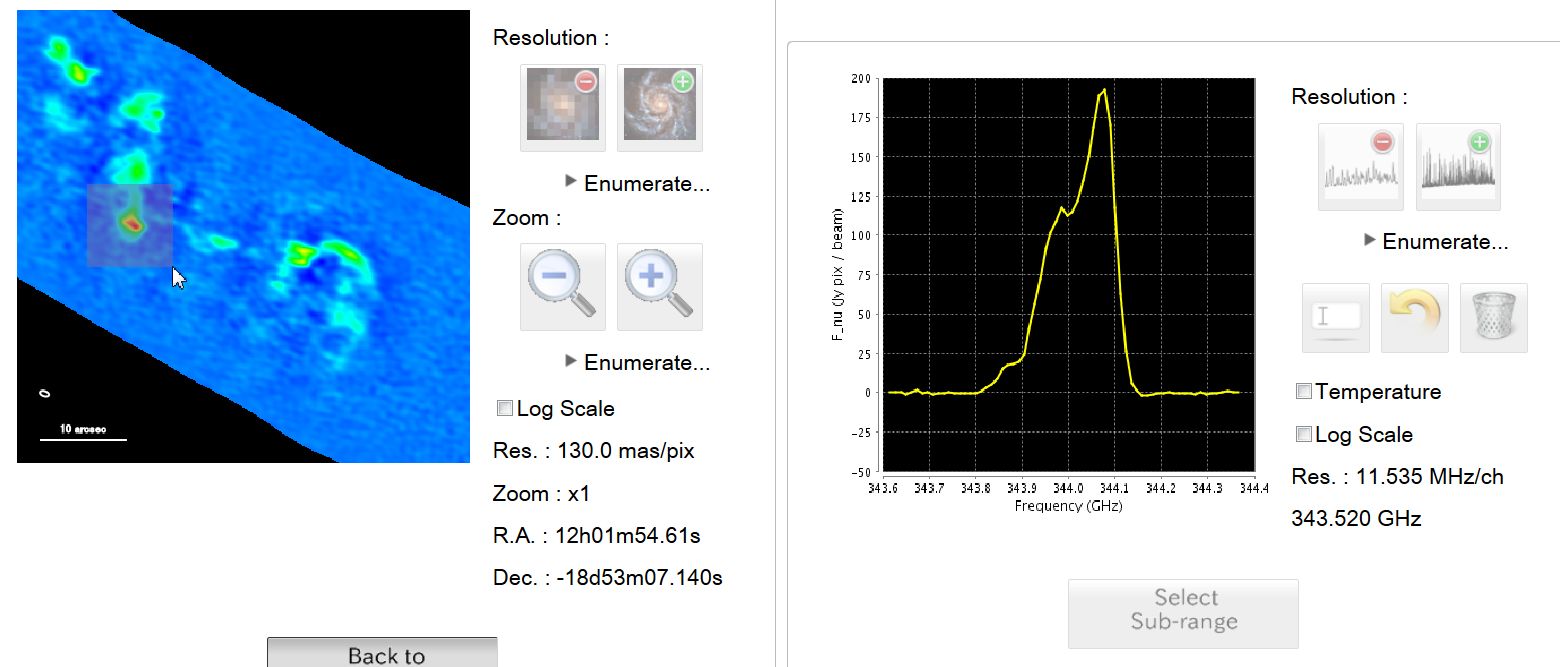
Vissage: ALMA VO Desktop Viewer
2013-10-01
The September 2013 issue of the IVOA Newsletter, which contain information about VO ALMA Data Service provided by NAOJ.